

Identify biologically active peptide signals in maize.

Plant SignalingAgricultural Biotechnology
Investigating How Plants Signal. Engineering Better Crop Responses.
Croptides is exploring how plant signaling peptides could improve crop resource efficiency and resilience.
Can peptide signaling help maize use nitrogen more efficiently?
Research Program01 / N-SIGNAL
Published foundation
Plants Signal Nitrogen Demand.
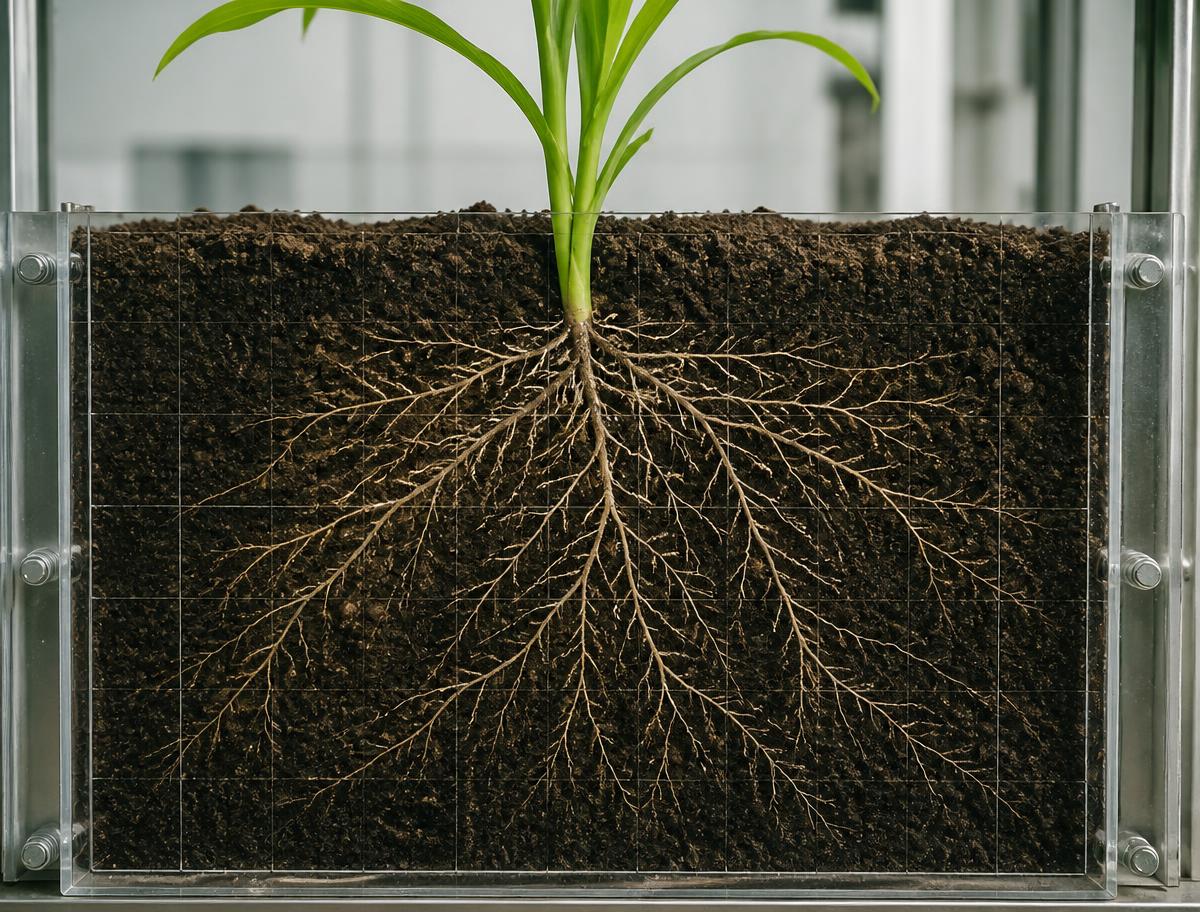
In Arabidopsis, nitrogen-starved roots produce C-terminally Encoded Peptides (CEPs). These root-derived signals are perceived in the shoot and initiate return signals that regulate nitrate uptake in other roots.
Peer-reviewed studies have identified CEPR receptors, mobile CEPD polypeptides, and regulation of the high-affinity nitrate transporter NRT2.1. Croptides is testing whether this biological rationale can translate to maize—not claiming that it already has.
Read the Published Science →SignalShort biological peptide
ResponsePlant signaling pathway
OutcomePotential change in nutrient acquisition, growth, or stress response
Science · 2014Tabata et al.Root-derived CEPs and systemic nitrogen-demand signalingNature Plants · 2017Ohkubo et al.Shoot-to-root CEPD signals regulate nitrogen acquisitionNature Communications · 2020Ota et al.CEPDL2 integrates shoot nitrogen statusAnnual Review · 2012Xu, Fan & MillerPlant nitrogen assimilation and use efficiency
Research program 01
Evaluating Peptide Signaling for Nitrogen-Use Efficiency in Maize.
Nitrogen fertilizer is critical to corn production, but nitrogen-use efficiency remains a major agricultural challenge.
N-Signal is Croptides' first research program. We are investigating whether CEP-family peptide signaling can improve nitrogen acquisition and whole-plant performance in maize under reduced nitrogen availability.
Published CEP signaling research provides biological rationale, but commercially useful improvement has not yet been demonstrated in maize. Published maize research has also shown that excessive CEP signaling can inhibit root growth.
Explore N-Signal Experiments →Determine the dose and delivery window that improves nitrogen response without unacceptable growth penalties.
Test whether the response persists under nitrogen conditions relevant to commercial agriculture.
Science first
Evidence-Based Progress.
Early biotechnology programs can waste enormous amounts of capital proving increasingly complicated versions of the wrong hypothesis. Croptides is taking the opposite approach.
Our first studies are being designed around explicit kill criteria.
View Research Roadmap →Dose
Test across orders of magnitude rather than assuming one concentration is beneficial.
Delivery
Compare biologically relevant delivery routes.
Realistic nitrogen
Determine whether activity persists beyond severe nitrogen starvation.
Whole-plant performance
Measure nitrogen accumulation, biomass, and growth penalties together.
If N-Signal does not clear these gates, we stop or pivot.
Scientific Foundation
Roy et al.Frontiers in Plant ScienceSynthetic CEP1 and nutrient uptakeView research ↗Xu et al.Journal of Experimental BotanyZmCEP1 in maize kernel developmentView research ↗Ivanovici et al.Plant PhysiologyCEP receptor signaling and downstream responsesView research ↗Taylor et al.Journal of Experimental BotanyCEPR1 in cereal crop orthologsView research ↗
Links are to independent peer-reviewed publications and do not imply endorsement of Croptides or any commercial partnership.
Why peptides
Targeted Signals. Investigating Biological Efficiency.
Precise
Peptides can interact with defined biological signaling pathways.
Low-dose potential
Biological signaling may operate at extremely low concentrations.
Designable
Sequence, stability, potency, selectivity, and delivery may potentially be optimized.
Platform potential
Different signaling pathways could eventually address different crop challenges.
These are characteristics of peptide signaling as a technology class and do not represent demonstrated Croptides product performance.
Platform vision
N-Signal as a Foundational Research Program.
If the initial biology validates, Croptides intends to build a broader discovery platform around crop-specific signaling peptides and delivery systems.
Current research programN-Signal
Nitrogen
Drought
Heat
Salinity
Root Architecture
Nutrient Acquisition
Plant Stress
Crop Quality
Future programs would only advance after experimental validation and commercial feasibility analysis.
Our development model
A Capital-Efficient Biotech Model.
Croptides is being structured as a capital-efficient virtual biotechnology company.
Discover
Published biology + computational research
Design
Peptide candidates + experiments
Validate
University and specialist research partners
Protect
Novel molecules, formulations, and methods
Scale
Grants + strategic partnerships
Commercialize
Licensing, partnership, or direct product development
Rather than building laboratories prematurely, Croptides intends to use university collaborations, specialist laboratories, outsourced peptide manufacturing, and non-dilutive research funding to validate technology before making large capital commitments.
Collaboration
We Are Looking for Scientists Who Want to Answer Hard Questions.
Croptides is actively seeking researchers with expertise across plant signaling and crop science.
- +Plant peptide signaling
- +Maize physiology
- +Nitrogen-use efficiency
- +Plant molecular biology
- +Nutrient transport
- +Peptide delivery
- +Crop agronomy
We are especially interested in research partners willing to help design experiments that can disprove our hypotheses quickly.
Discuss a Research Collaboration →Get in touch
Contact Us.
We are interested in discussing research, partnerships, and investment opportunities related to crop resource efficiency.
Scott MansfieldFounder & CEOhello@croptides.com