Identification of a biologically active, small, secreted peptide in Arabidopsis
Ohyama, Ogawa & Matsubayashi. Biochemically identified an active CEP peptide using in-silico screening and LC–MS structure analysis.

Published research
CEP signaling provides a peer-reviewed biological foundation for asking whether targeted peptide treatments could influence crop nitrogen response.
What is established
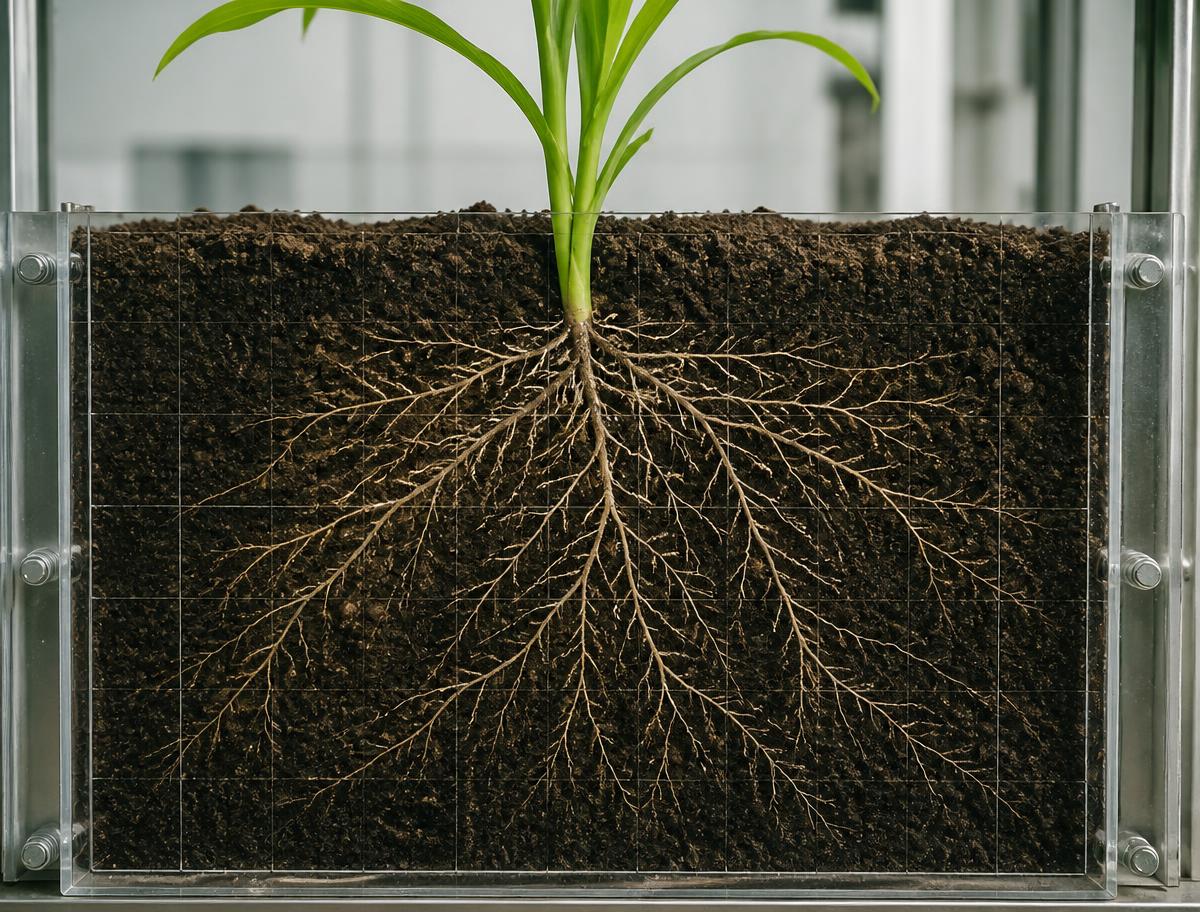
When part of an Arabidopsis root system experiences nitrogen limitation, CEP peptides produced in roots travel to the shoot. CEPR receptor kinases perceive the signal, and mobile CEPD-family polypeptides carry a response back toward roots with available nitrate.
That downstream response regulates genes including the high-affinity nitrate transporter NRT2.1. The published mechanism is compelling, but most foundational work is in model plants under controlled conditions.
These studies establish biological mechanisms; they do not demonstrate a commercial CEP treatment, improved maize yield, or field-scale nitrogen-use efficiency.
Selected literature
Ohyama, Ogawa & Matsubayashi. Biochemically identified an active CEP peptide using in-silico screening and LC–MS structure analysis.
Tabata et al.. Showed that root-derived CEP signals are perceived by shoot CEPR receptors to coordinate compensatory nitrate uptake.
Ohkubo et al.. Identified CEPD1 and CEPD2 as mobile shoot-to-root signals downstream of CEP perception that regulate NRT2.1.
Ota et al.. Established CEPDL2 as an additional mobile signal integrating whole-shoot nitrogen status with root nitrate uptake.
Zhang et al.. Reported increased local nutrient uptake rates after synthetic CEP1 application in a controlled experimental system.
Xu, Fan & Miller. Reviewed the transport, assimilation, remobilization, and systems-level traits that determine plant nitrogen-use efficiency.
Croptides methodology
The work below describes our planned experimental framework, not completed studies or reported results.
Compare maize CEP sequences, post-translational forms, receptor orthologues, and literature-supported controls before synthesis.
Screen orders of magnitude across root-zone and foliar delivery while tracking peptide stability and root-growth penalties.
Measure time-resolved expression of nitrate-transport and signaling markers, paired with direct nitrogen-uptake measurements where feasible.
Advance only responses that improve nitrogen accumulation or performance under relevant nitrogen regimes without unacceptable trade-offs.
See how this framework becomes testable hypotheses in our first program.
Explore N-Signal →